Glasses have been a trusted solution for blurry vision for centuries. They work, they are familiar, and for many people they have simply become part of who they are. But a quiet revolution is taking place in eye care — and it is happening right here in Indore.
More and more people are walking through the doors of eye clinics not to update their prescription, but to ask one question: can I get rid of my glasses for good? The answer, for the vast majority of suitable candidates, is a resounding yes — thanks to LASIK laser eye surgery.
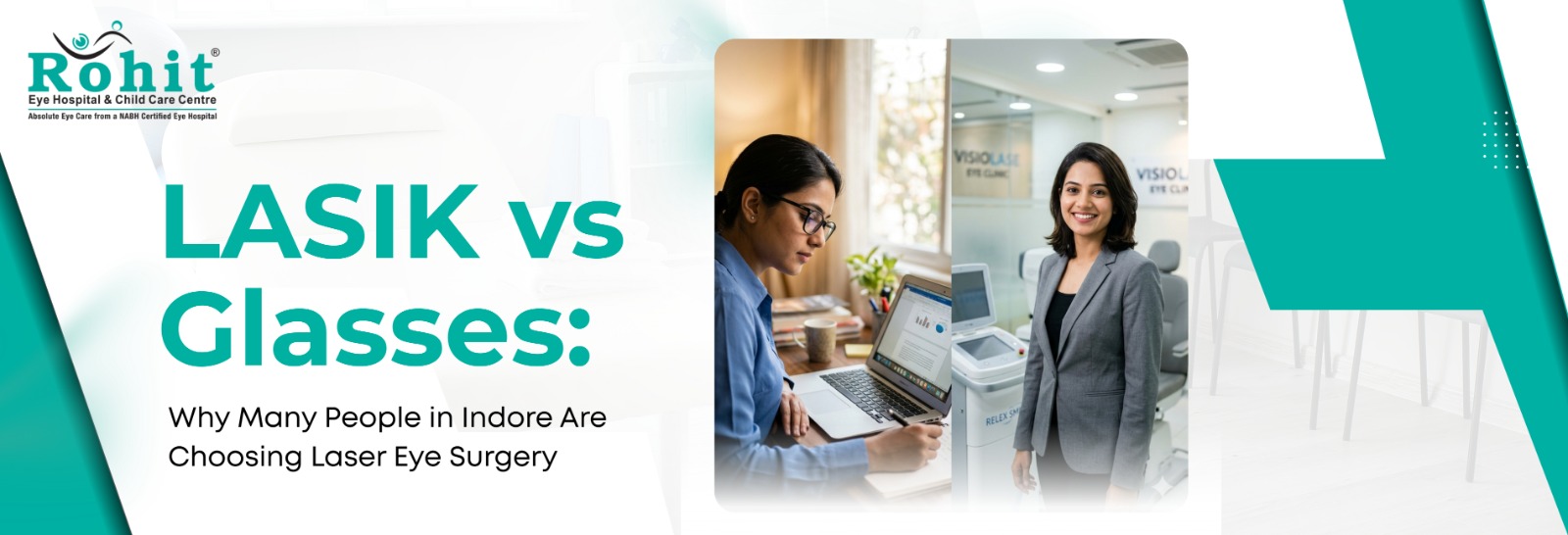
The LASIK vs glasses debate is one of the most common conversations our doctors have at Rohit Eye Hospital every single day. Both are legitimate options for correcting refractive errors like myopia, hyperopia, and astigmatism. But they are fundamentally different in what they offer, what they cost over time, and how they affect your day-to-day life.
In this comprehensive guide, we break down the real differences between laser eye surgery vs glasses, explore the key LASIK surgery benefits, and help you understand why LASIK vision correction has become the choice of an ever-growing number of patients seeking the best quality of life — without the daily frustration of frames and lenses.
Understanding the Basics: How Do Glasses and LASIK Work?
How Glasses (and Contact Lenses) Work
Glasses and contact lenses are external corrective devices. They work by bending (refracting) incoming light before it enters the eye, compensating for the eye’s refractive error and helping light focus correctly on the retina. They do not change the eye itself — they simply sit in front of it (or on it, in the case of contacts) and redirect light.
Glasses are effective and safe but they are a daily aid, not a cure. Remove them and your blurred vision returns immediately. Your prescription is likely to change over time, requiring regular updates and new lenses.
How LASIK Laser Eye Surgery Works
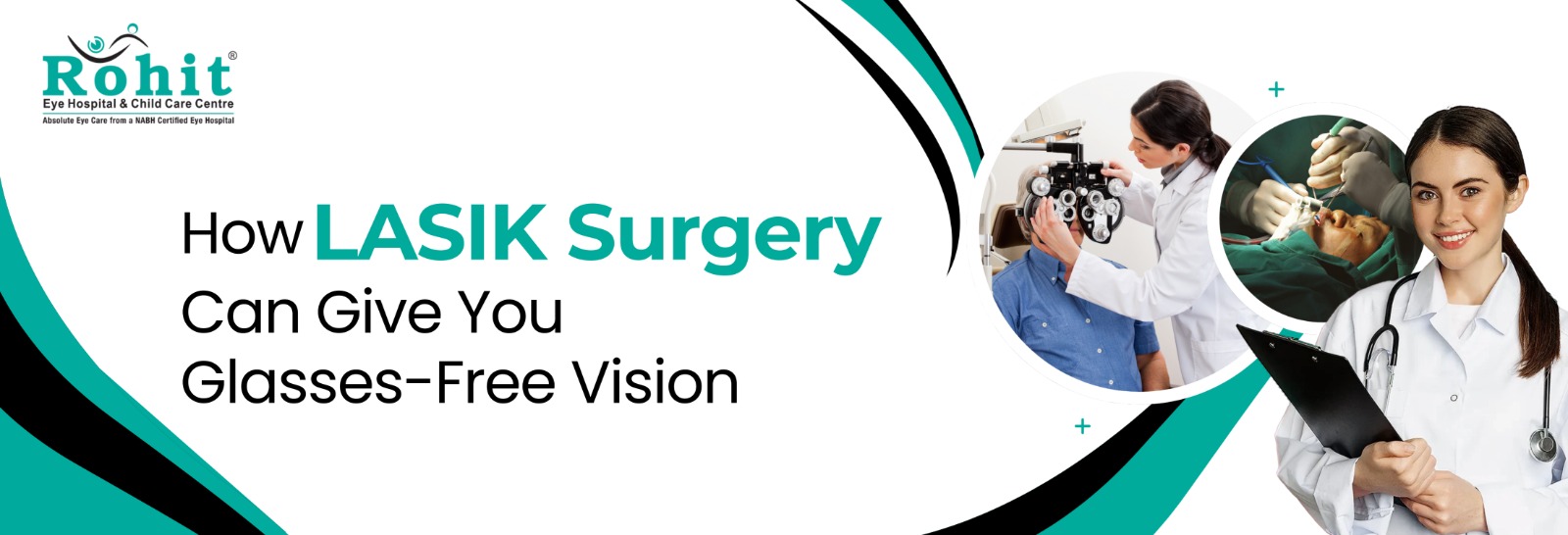
LASIK (Laser-Assisted In Situ Keratomileusis) takes a fundamentally different approach. Instead of redirecting light outside the eye, it permanently reshapes the cornea — the transparent front surface of your eye — so that light focuses precisely on the retina without any external aid.
Using an ultra-precise excimer laser guided by a detailed map of your cornea, the surgeon removes microscopic amounts of corneal tissue to correct your specific prescription. The result is a permanent change to the optical structure of your eye. For most patients, this means waking up the very next morning with clear, unaided vision — often 6/6 or better.
LASIK vs Glasses: A Detailed Side-by-Side Comparison
| Category | LASIK Surgery | Glasses / Contact Lenses |
| Vision quality | Sharp, natural, unaided — often 6/6 or better | Good but dependent on frame alignment and lens quality |
| Convenience | No daily routine — wake up and see clearly | Must be worn every waking moment; easy to forget or misplace |
| Long-term cost | One-time investment; no recurring costs | Ongoing cost: new frames, lenses, solutions every 1–2 years |
| Physical comfort | No pressure on nose/ears; no fogging or slipping | Discomfort in heat, rain, sports; fogging with masks |
| Sports & outdoor activity | Ideal — no restrictions after recovery | Risk of breakage; limits certain sports and activities |
| Night vision / optics | Excellent with advanced Contoura LASIK | Reflections, glare from frame edges and thick lenses |
| Peripheral vision | Full, natural 360° vision | Limited by frame edges; distortion at lens periphery |
| Appearance | No change to appearance | Frames may not suit all face types or preferences |
| Recovery time | 24–48 hours; most resume work in 2 days | Immediate — no recovery needed |
| Permanence | Permanent corneal correction | Requires regular updates as prescription changes |
| Dependence on prescription | Eliminated for most patients | Lifelong dependence on updated prescriptions |
LASIK Surgery Benefits: The Real Reasons People Are Switching
The numbers speak for themselves — LASIK is one of the most commonly performed elective surgical procedures in the world, with over 40 million procedures done globally. Here is why patients at our LASIK eye clinic in Indore consistently choose laser eye surgery over continuing with glasses:
1. Freedom and Spontaneity
Ask anyone who has had LASIK what surprised them most, and the answer is almost always the same: the freedom. No more reaching for glasses first thing in the morning. No more panic when you cannot find them. No more awkward moments at the pool or beach. No more fogged-up lenses on a cold morning or in a humid Indore summer.
LASIK gives you the ability to simply open your eyes and see — clearly, immediately, without any apparatus between you and the world. This spontaneous quality of life improvement is consistently rated as one of the top LASIK surgery benefits by patients after the procedure.
2. Superior Visual Quality
Glasses correct your central vision well but come with inherent optical limitations. The edges of lenses introduce distortion. Frames create blind spots in peripheral vision. Thick lenses magnify or minify objects subtly. Smudges, scratches, and misalignment further compromise clarity.
Advanced LASIK vision correction — especially Contoura Vision and Wavelight Plus Innoveyes LASIK available at Rohit Eye Hospital — goes beyond simply matching your glasses prescription. It corrects higher-order aberrations: subtle corneal irregularities that glasses simply cannot address. Many patients report that their vision after LASIK is actually sharper and crisper than what their best glasses ever delivered, particularly in low-light conditions.
3. Long-Term Cost Savings
This is a LASIK surgery benefit that many people overlook when comparing laser eye surgery vs glasses. Glasses feel affordable because the cost is spread out over time — but when you add it up across a lifetime, the picture changes dramatically.
Consider the recurring expenses of being a glasses wearer:
• New frames every 2–3 years (often ₹2,000–₹15,000 or more for quality frames)
• Updated lenses every 1–2 years as prescription changes (₹3,000–₹12,000 for progressive or anti-reflection lenses)
• Contact lens costs: lenses, solutions, cases — ₹6,000–₹20,000 per year
• Backup pairs of glasses
• Specialist consultations for prescription updates
Over 10–15 years, a glasses wearer may spend ₹80,000 to ₹2,50,000 or more. A single LASIK surgery in Indore is a one-time investment — and once done, the ongoing costs are essentially zero. For most patients, LASIK pays for itself within five to seven years.
4. Ideal for an Active Lifestyle
Indore is a city on the move — and whether you are a cricket enthusiast at Nehru Stadium, a swimmer, a gym regular, a cyclist on the Narmada cycle track, or simply someone who lives a fast-paced professional life, glasses can genuinely get in the way.
Contact lenses, while helpful for sports, carry their own risks during outdoor activities including dust, debris, and infection — especially in Indore’s climate. LASIK laser eye surgery advantages include unrestricted participation in virtually any sport or physical activity after a short recovery period, without the worry of broken frames or displaced lenses.
5. Professional and Social Confidence
While glasses are widely accepted — and even fashionable — many patients report that having spectacle-free vision has a meaningful positive impact on their personal and professional confidence. From job interviews to wedding photographs, from presentations to first impressions, many patients simply feel more confident without frames on their face.
6. Safety in Emergencies
A less commonly discussed but very real laser eye surgery advantage: in an emergency situation — a fire, a medical event, a fall in the night — the ability to see clearly without needing to locate and put on glasses can genuinely matter. Patients who have had LASIK consistently describe a deeper sense of security knowing their vision is always with them.
Addressing Common Concerns: Is LASIK Really Better Than Glasses?
The LASIK vs glasses question is not always straightforward. Some patients have genuine concerns about laser eye surgery that deserve honest answers.
Concern 1: ‘LASIK is too expensive’
Reality: LASIK surgery in Indore is a one-time cost, typically ranging from ₹15,000 to ₹55,000 per eye depending on the technology chosen. When compared against a lifetime of recurring glasses and contact lens expenses, most patients find that LASIK is more economical over a 7–10 year period. Our team at Rohit Eye Hospital always provides a transparent cost breakdown so you can make an informed decision.
Concern 2: ‘LASIK is risky’
Reality: LASIK is one of the most studied and refined surgical procedures in medicine. Serious complications are rare — especially when performed on properly screened candidates by experienced surgeons using advanced technology. At Rohit Eye Hospital, every patient undergoes a thorough pre-operative assessment. We decline to perform LASIK on patients who are not suitable candidates, because your safety is our highest priority.
Concern 3: ‘My prescription is too high for LASIK’
Reality: LASIK can treat myopia up to approximately -10D, hyperopia up to +4D, and astigmatism up to 5D. Patients outside these ranges may be suitable for alternative procedures such as Phakic IOL, Clear Lens Extraction, or Trans PRK. There are very few patients for whom no surgical vision correction option exists.
Concern 4: ‘I will still need reading glasses after 40’
Reality: This is true for patients who develop presbyopia (age-related near vision loss), which affects virtually everyone after 40. However, LASIK corrects your distance vision. Presbyopia is a separate condition caused by lens stiffening — not the cornea — and is independent of LASIK. Options such as monovision LASIK or PRESBYOND can address this. Our team will explain your full range of options clearly during consultation.
Concern 5: ‘What if LASIK wears off over time?’
Reality: LASIK permanently changes the shape of your cornea. The surgery itself does not wear off. However, if your prescription was not fully stable at the time of surgery, or if your eyes continue to change naturally with age, an enhancement procedure may occasionally be needed. This is why we recommend LASIK only for patients with a stable prescription.
Is LASIK Right for You? Candidacy at a Glance
LASIK vision correction is not for everyone — and a responsible eye hospital will tell you that honestly. Here is a quick overview of who typically benefits most from LASIK surgery in Indore:
| Category | LASIK Surgery | Glasses / Contact Lenses |
| Age | 18–45 years (ideally 21+) | Any age |
| Prescription | Myopia up to -10D, Hyperopia up to +4D, Astigmatism up to 5D | All prescriptions |
| Corneal thickness | Must be adequate for safe ablation | Not applicable |
| Prescription stability | Stable for at least 12 months | Can change anytime (new lenses needed) |
| Dry eye | Mild to none; moderate-severe may be excluded | No restriction |
| Lifestyle | Active, sports-oriented, professional | Suitable for all lifestyles |
| Motivation | Strong desire to be spectacle-free | Happy with visual aid dependence |
The only way to know for certain whether you are a suitable LASIK candidate is a comprehensive pre-operative evaluation. Our team at Rohit Eye Hospital offers thorough pre-LASIK screenings including corneal topography, pachymetry, dry eye assessment, and refraction analysis.
LASIK Surgery in Indore: Why Rohit Eye Hospital?
Choosing where to have LASIK is just as important as choosing to have it. Here is why patients across Indore and Central India trust Rohit Eye Hospital for LASIK vision correction:
• 30+ years of ophthalmology excellence — established in 1991
• First NABH-accredited eye hospital in Indore and first ECO-category NABH accreditation in Madhya Pradesh (2021)
• State-of-the-art Wavelight Plus Innoveyes laser platform — one of the fastest, most precise excimer laser systems in India
• Bladeless Contoura Vision LASIK — topography-guided for superior quality of vision
• Conventional / Microkeratome LASIK for cost-effective standard correction
• Experienced refractive surgeons who have performed thousands of successful procedures
• Comprehensive pre-operative screening — we never compromise on candidacy assessment
• Transparent pricing with no hidden fees
• Three branches in Indore: LIG Square, Sapna Sangeeta, and Scheme 140
• Post-operative care and follow-up at every stage of your recovery
What to Expect: The LASIK Journey at Rohit Eye Hospital
Step 1 — Free Consultation: Discuss your vision goals and lifestyle with our refractive surgery team.
Step 2 — Pre-operative Evaluation: Corneal topography, pachymetry, dry eye testing, refraction, and pupil assessment.
Step 3 — Surgery Day: The procedure takes 10–15 minutes per eye. Anaesthetic drops are applied — no injections, no pain. You are awake throughout and asked to look at a fixation light.
Step 4 — Immediate Results: Most patients notice dramatically improved vision within hours. You rest briefly at the clinic before going home with a protective eye shield.
Step 5 — Recovery: Most patients return to desk work within 1–2 days. Avoid swimming, rubbing your eyes, and dusty environments for 2 weeks. Use prescribed drops as directed.
Step 6 — Follow-up: Check-ups at day 1, week 1, month 1, and month 3 ensure your eyes are healing perfectly and your vision has stabilised.
Frequently Asked Questions: LASIK vs Glasses
Q1. How long does LASIK last — will I ever need glasses again?
LASIK permanently changes the corneal shape. The correction does not fade. However, age-related presbyopia (reading difficulty after 40) and natural eye changes over decades may eventually require reading glasses or an enhancement. The vast majority of patients remain spectacle-free for distance vision for 10, 20, or more years.
Q2. Can I have LASIK if I wear contact lenses?
Yes — contact lens wearers are among the most enthusiastic LASIK candidates. You will need to stop wearing soft contact lenses for at least 1–2 weeks before your pre-operative evaluation (longer for rigid lenses) to allow your corneas to return to their natural shape for accurate mapping.
Q3. Is LASIK surgery painful?
No. Anaesthetic eye drops are applied before the procedure, completely numbing the eye. Most patients feel only a brief sensation of mild pressure lasting a few seconds. There is no pain during surgery. Some patients experience mild irritation or a gritty feeling for a few hours afterward, which resolves quickly.
Q4. At what age is LASIK best done?
LASIK is ideally performed between the ages of 21 and 40, when the prescription is stable and the corneas are at their healthiest. Patients up to 45 can still be excellent candidates, though those over 40 may need to discuss presbyopia management alongside their LASIK plan.
Q5. What is the success rate of LASIK?
LASIK has one of the highest patient satisfaction rates of any elective surgical procedure. Studies consistently show that over 95% of patients achieve 6/6 or better vision, and more than 96% report being satisfied or very satisfied with their outcome. Advanced platforms such as Contoura Vision push these numbers even higher.
Q6. Can both eyes be done on the same day?
Yes. In the vast majority of cases, both eyes are treated on the same day for patient convenience and faster visual recovery. Your surgeon will advise if treating one eye at a time is more appropriate for your individual case.
Conclusion
The LASIK vs glasses decision ultimately comes down to what you want from your vision — and your life. Glasses will always be a safe, accessible, reversible option. There is nothing wrong with wearing them. But if you are tired of the daily dependency, the recurring costs, the physical limitations, and the compromised visual quality that comes with frames and lenses, laser eye surgery offers something genuinely transformative.
LASIK vision correction is not just about seeing better — it is about living better. The laser eye surgery advantages go far beyond a sharper prescription. They touch your mornings, your sport, your confidence, your freedom, and your long-term finances.
At Rohit Eye Hospital, we have helped thousands of patients in Indore make this life-changing transition — safely, precisely, and with lasting results. Our job is not to sell you LASIK. It is to help you understand whether LASIK is right for you and if it is, to give you the very best outcome possible.
Take the first step. Your clearest vision is waiting.